Launch pricing: the full kit, 175 illustrated pages, is $37 while we're newLaunch pricing: full kit, 175 pages for $37
What to Say cover Notes, Plans and Boundaries cover Session Questions cover

Your First Caseload. Explained With Drawings.

Three illustrated field guides for counselors, therapists and social workers in their first years: what to say in session, from the first five minutes to the last goodbye; notes, treatment plans, consent, supervision and boundaries; and 147 questions for every phase of the work. One idea a page, each one drawn.

Secure purchase No subscription 7-day guarantee
Here's what the pages look like

Real pages from all three guides. One idea a page, drawn.

What's included

Three illustrated guides

What to Say, Notes, Plans and Boundaries, and Session Questions. 175 pages, one idea each.

The words, not just the theory

The idea, the picture, the words to try, the common slip and one line to remember. Read it between sessions.

Made for your phone

Phone-sized PDFs, plus SOAP, DAP, GIRP and treatment-plan templates to print and copy. Yours to keep. Nothing to cancel.

School taught you the theory. Nobody told you what to say.

The first year is full of moments no lecture covered: a long silence, a client who asks if you're new, a note due before the next session, a supervision hour with too much to bring. Every one of them has a page, and every page names the slip new clinicians make.

Where the first year gets hard:

Filling every silence, just before the client says the important thing

Rushing the limits of confidentiality as a list of legal words in the first session

Bringing a story to supervision instead of a question, and running out of time for the help you needed

From Book 1 · Hard moments

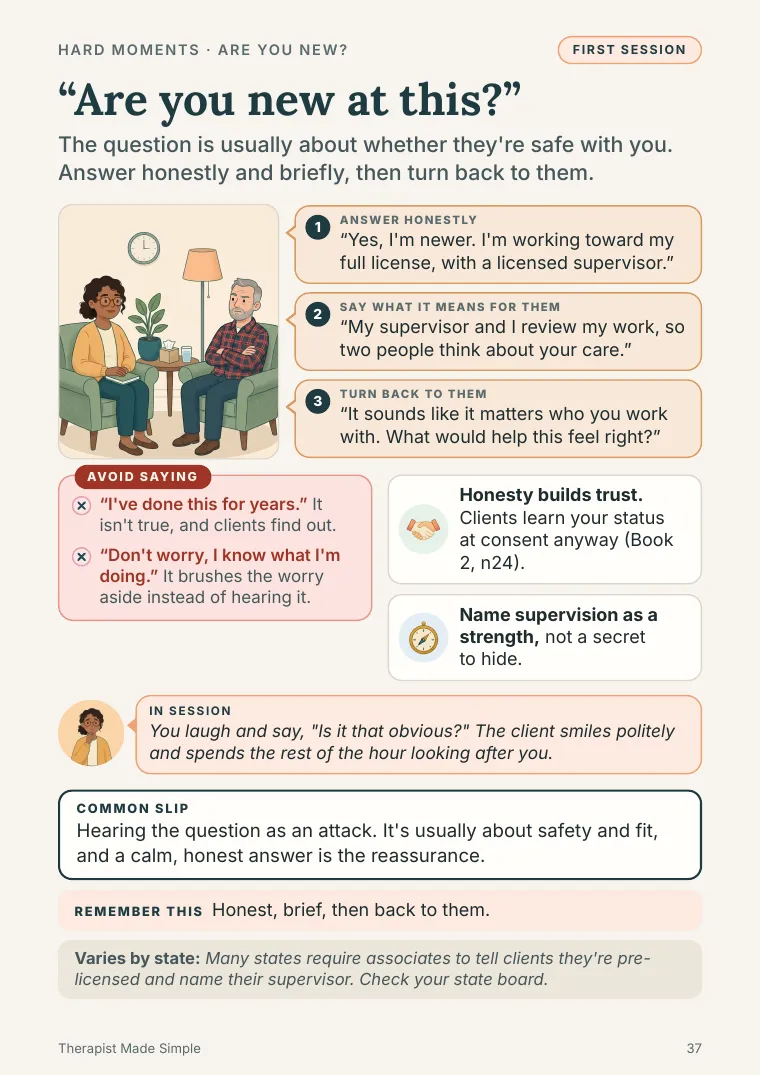
“Are you new at this?”

Book 1, page 37, Are you new at this?: answer honestly, say what it means for them, turn back to them
From Book 1 · page 37
Remember this Honest, brief, then back to them.
The words “Yes, I'm newer. I'm working toward my full license, with a licensed supervisor.”

A drawing is easier to take in between sessions than a chapter. That's why every page in the kit has one, and one line to keep.

Same degree, same caseload. A very different first year.

From this

Figuring it out alone

  • A forum thread at midnight about what to say when a client asks if you're new
  • A textbook chapter on the theory, and no words for the moment you're in
  • A note written from memory at the end of a long day
To this

The page for this moment

  • One idea, one drawing, read in a minute
  • The words to try, and what to avoid saying, on the same page
  • The common slip named, so you skip it

One page, up close

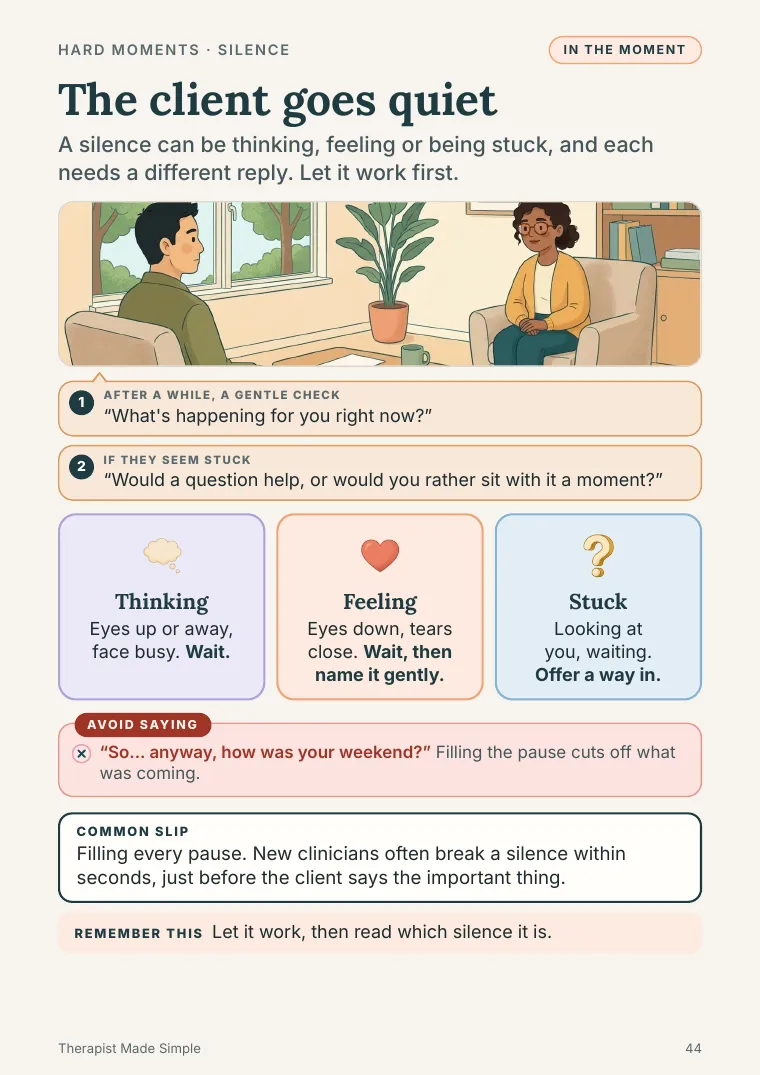
Every page has the same parts, so you always know where to look. Here is Book 1, page 44, The client goes quiet, with its lines quoted from the guide.

Book 1, page 44, The client goes quiet: the whole page
The idea

A silence can be thinking, feeling or being stuck, and each needs a different reply. Let it work first.

The words

“What's happening for you right now?”

Common slip

Filling every pause. New clinicians often break a silence within seconds, just before the client says the important thing.

Remember this

Let it work, then read which silence it is.

Quoted word for word from Book 1, page 44, The client goes quiet. Every page carries these parts plus the drawing, and where a rule changes from state to state, a note that says so.

The three guides

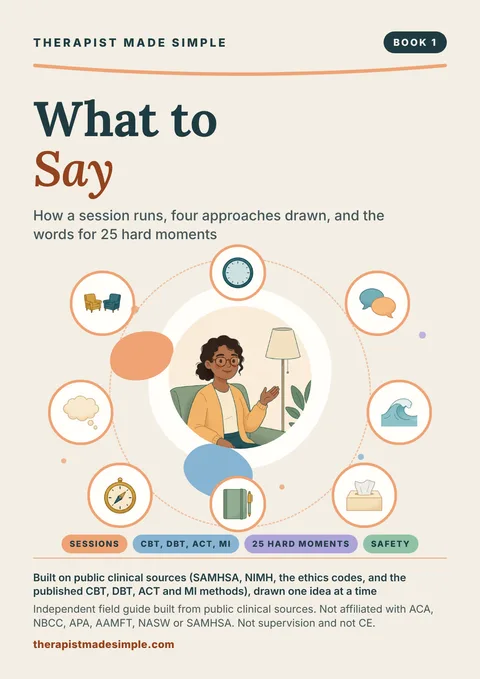
Book 1: What to Say

68 pagesEleven partsEvery page drawn25 hard moments

How a session runs, four approaches drawn, and the words for 25 hard moments, one idea a page. Start with the first five minutes.

  • The shape of a session: before the first session, the first five minutes, asking what brought them now, intake without an interrogation, closing a session, and the last session
  • Four approaches, drawn: CBT's thoughts, feelings and actions and the thought record, DBT's four skill areas, ACT's six processes, and motivational interviewing's spirit and OARS
  • Hard moments: silence, “Are you new at this?”, “Have you been through this?”, a client upset with you, rupture and repair, no-shows and late cancels, gifts and more, each with what to say, what to avoid and why
  • Safety in session, as process only: asking directly, following your agency's protocol and your supervisor, and noting the conversation

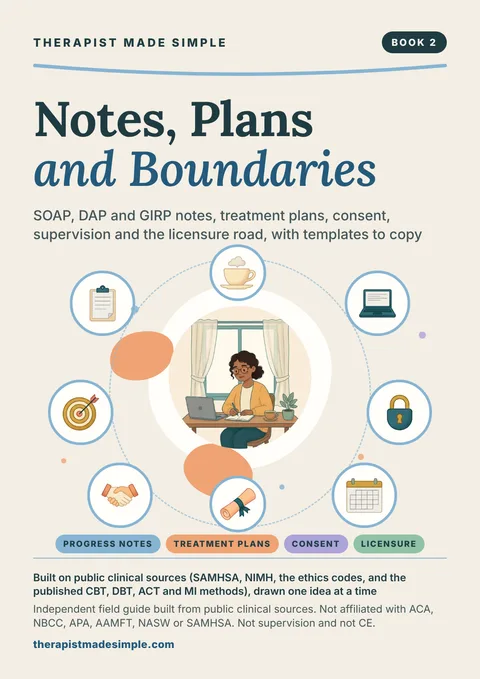
Book 2: Notes, Plans and Boundaries

57 pagesEight partsSix templatesNotes to licensure

The paperwork and the professional side, in the same layout, with templates to copy at the back.

  • Notes: what a progress note is for, observations not judgments, SOAP, DAP and GIRP explained and filled in, which format to use, corrections and late entries
  • Plans: what a treatment plan holds, goals in the client's own words, SMART objectives, interventions that match the goal, reviewing the plan, a plan filled in
  • Consent and supervision: informed consent, telling clients you are supervised, the limits of confidentiality said plainly, releases, minors, couples, telehealth, and what to bring to supervision
  • Boundaries, self-care and licensure: caseload, fees, dual relationships, your online presence, after a hard session, a week you can sustain, supervised hours and how to check your state's rules
  • Templates to copy: SOAP, DAP and GIRP notes, a treatment plan, a supervision prep sheet and a supervised hours log

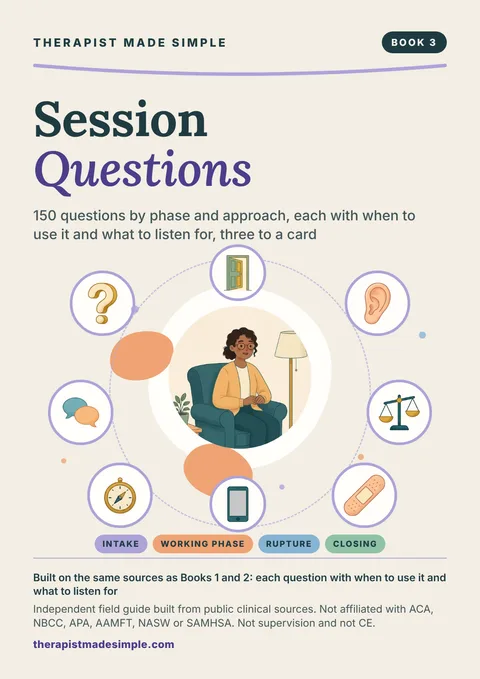
Book 3: Session Questions

50 cards147 questionsPhone and printSeven phases

Three questions to a card, each with when to use it and what to listen for. A phone deck, plus a print deck two cards to a sheet.

  • Intake and assessment: opening the first session, what brought them in, what they have tried, their life outside the room, strengths, hopes, sleep, stress and coping, and asking about safety directly
  • Goals: picturing change, making goals concrete, scaling questions, values and readiness to change
  • The working phase: exploring one moment, patterns across the week, and questions drawn from CBT, DBT, ACT and motivational interviewing
  • Stuck, repair and closing: when the session goes in circles, when “I don't know” repeats, noticing and repairing a rupture, closing a session, reviewing progress and the last session

Here's everything you get

Notes, Plans and Boundaries What to Say Session Questions

The Therapist Made Simple Kit

  • What to Say73 PDF pages, 68 teaching pages: how a session runs, four approaches drawn, and the words for 25 hard moments
    $37
  • Notes, Plans and Boundaries62 PDF pages, 57 teaching pages: SOAP, DAP and GIRP notes, treatment plans, consent, supervision, boundaries and six templates
    $29
  • Session Questions50 cards, 147 questions by phase, with when to use each and what to listen for; phone and print decks
    $19

Total value: $85

Launch price
$37

One-time payment. No subscription. Keep the files forever.

Yes, I want the kit for $37
Secure purchase No subscription 7-day guarantee
Payments by Stripe

Digital guides (PDF), in English. We email your library link right after purchase, and you can download the files again anytime. Plus sales tax where applicable.

Therapist Made Simple is an independent field guide for new clinicians, built from public clinical sources. It is not supervision, not a license course and not continuing education (CE). It is not affiliated with any licensing board or professional association.

Is this kit for you?

Starting your first clinical job, or about to

You know the theories; the room is new. Book 1 walks the first session minute by minute, then the moments that catch new clinicians out, with the words to try.

An associate or resident, working toward licensure

Notes, treatment plans, consent, supervision and your hours each get a page, with filled examples and templates to copy, and how to check your own state's rules.

Seeing clients, and stuck for the next question

Session Questions gives you three questions to a card for every phase, from intake to the last session, each with when to use it and what to listen for.

How this kit is made

A field guide built from public clinical sources, drawn clearly, with the source named on the page. It is not supervision, not a license course, and not CE.

Built on named sources

SAMHSA's Treatment Improvement Protocols, NIMH, APA practice guidance and the professional ethics codes, the Beck Institute's public CBT materials, Linehan's DBT skills and Hayes's ACT (described and cited, never copied) and Miller and Rollnick's motivational interviewing. Every page was checked against its named sources before release.

Honest about your state

Licensure, supervision rules, reporting duties and minors' rights change from state to state. Those pages teach the shared pattern, say "Varies by state" where it matters, and show you how to check your own board and law.

Process, not decisions

On safety and reporting, the guides describe the process: ask directly, follow your agency's protocol, talk to your supervisor, write the note. They never tell you what to decide. Your supervisor and your agency come first.

Independent, on purpose

Not affiliated with or endorsed by the American Counseling Association (ACA), the National Board for Certified Counselors (NBCC), the American Psychological Association (APA), the American Association for Marriage and Family Therapy (AAMFT), the National Association of Social Workers (NASW), SAMHSA or any state licensing board.

7-day money-back guarantee

Use the kit for 7 days. If it isn't for you, email us and you get 100% of your money back. No fine print, no hassle.

Questions, answered

How do I get it?

Right after purchase we email you a link to your library, where you download all three guides as PDFs. You can come back and download them again anytime.

Is this a one-time payment or a subscription?

One-time payment of $37. No subscription, no recurring charges, and nothing to cancel. All three guides are yours to keep.

Who is it for?

Counselors, therapists and social workers in their first years: associates, residents, interns and anyone working toward licensure. It is written for the first caseload.

Is it supervision, a license course or CE?

No. Therapist Made Simple is an independent field guide for new clinicians, built from public clinical sources. It is not supervision, not a license course and not continuing education (CE). It is not affiliated with any licensing board or professional association. Your supervisor, your agency's policies and your state's rules come first.

Which state is it for?

Every state. The guides teach what works the same way everywhere: how a session runs, notes, plans and the questions to ask. Where a rule changes by state, like licensure, reporting or minors' consent, the page says so and shows you how to check yours.

Do I need to buy anything else?

No. The kit is complete on its own.

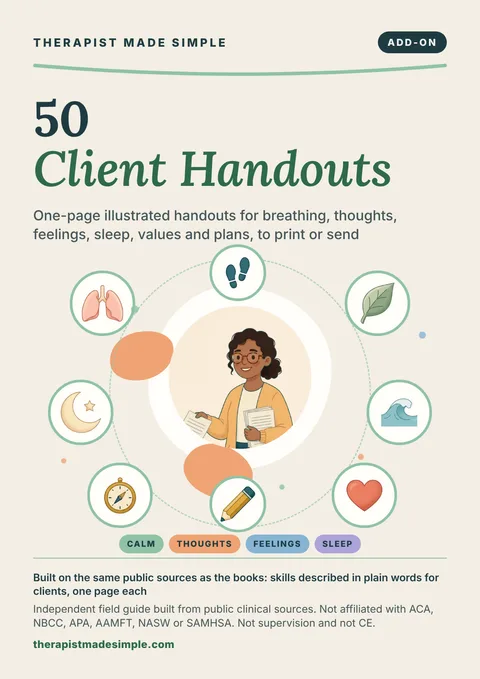
50 Client Handouts cover

At checkout there is one optional add-on, the 50 Client Handouts: one-page illustrated handouts to give a client between sessions, like belly breathing, grounding, a thought record, sleep habits and worry time. It's $19, unticked, and you can skip it.

Can I use it on my phone? Can I print it?

Both. The pages are portrait and phone-sized, so you can check one between sessions, and the PDFs print, including the note and treatment-plan templates.

Will it make me a good therapist?

We don't promise that, and we'd be wary of anyone who does. The guides show you how each piece works, the words to try and the common slip. Supervision, practice and your own judgment do the rest.

What if it isn't for me?

Email us within 7 days of purchase and we'll refund 100% of your money. Details on the refund policy page.

One last thing before you decide

Every week of your first year brings a moment no class covered. You don't need another midnight forum thread. You need the page for this moment, with the idea drawn, the words to try and the slip named.

Get instant access
Access confirmed ·
Full kit$37
Get instant access
The full kit · $373 illustrated guides · 175 pagesGet instant access